How sustainability data collection finally works

Ask a group sustainability lead what the hardest part of their ESRS report is, and almost nobody says the report.
It is the data. It sits in different countries, different systems, different people. Energy is metered per site. Headcount sits in each subsidiary's payroll. Waste is with a plant manager who has never heard of ESRS and is not about to start caring in March.
So the usual answer is one enormous spreadsheet, mailed to two hundred colleagues, half of whom do not know what the columns mean. Then three months of chasing, and a consolidation done by hand.
The facts
- A group report is assembled from data that does not live at group level. Emissions are calculated per site. Social and workforce data sit in each entity. What genuinely lives at the top, like board composition, is the exception rather than the rule.
- This, not the report, is what customers say hurts. Across roughly sixty customer conversations, the two pains that came out top were manual data collection and the fact that consolidating across entities is unmanageable.
- The competition is not another tool. It is Excel, and Excel is genuinely good. It is flexible, universal, and everybody already knows how it works. What it does not give you is reliability, traceability, and a number validated by the person actually responsible for it.
- One entity is easy. Thirty-two is a different job. One manufacturer we work with collects across 32 entities, organised by division, country and activity, most of them not separate legal entities. Their contributors are controllers and plant managers working in four languages, several of them on no central system at all.
- Whether you report on time is decided at the bottom of the chain. If the person filling in the number finds the request confusing, they postpone it. Multiply that by thirty entities and a small central team spends its quarter chasing rather than reporting.
- A plausible number and a defensible number are not the same thing. An auditor asks which entity, which person, which document. A cell in a spreadsheet answers none of those, no matter how right it is.
Whether you report on time is decided by the person in the chain with the least reason to care.
Why the spreadsheet keeps winning
Because every attempt to replace it made the group's life easier at the expense of the entity's. Structure, definitions, validation, sign-off: all of it is good for the person consolidating, and all of it usually lands as extra work on the person at the bottom, who never asked for any of this.
The answer is not to discipline them into compliance. It is to make their side of the job genuinely smaller than the spreadsheet was. Get that right and the rest follows, because data that arrives on time is data somebody was willing to send.
What we built
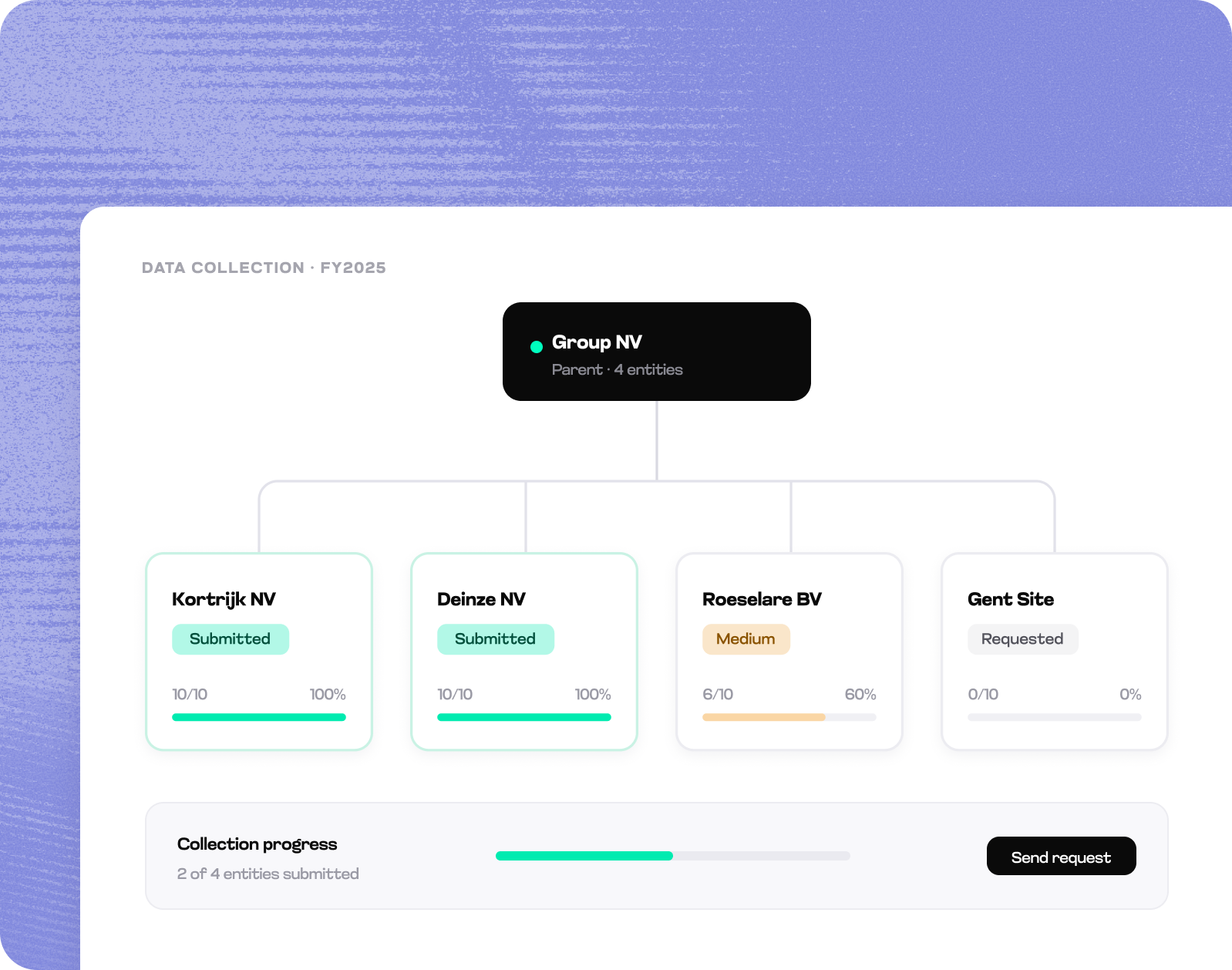
Karomia's data collection module turns your own org structure into a collection plan, then rolls what comes back into one group report. Six questions, in order.
- How is the group actually organised? —> The org map
- What genuinely needs to come up from each entity? —> The scoped data point set
- Who signs off on it? —> A named data owner per entity
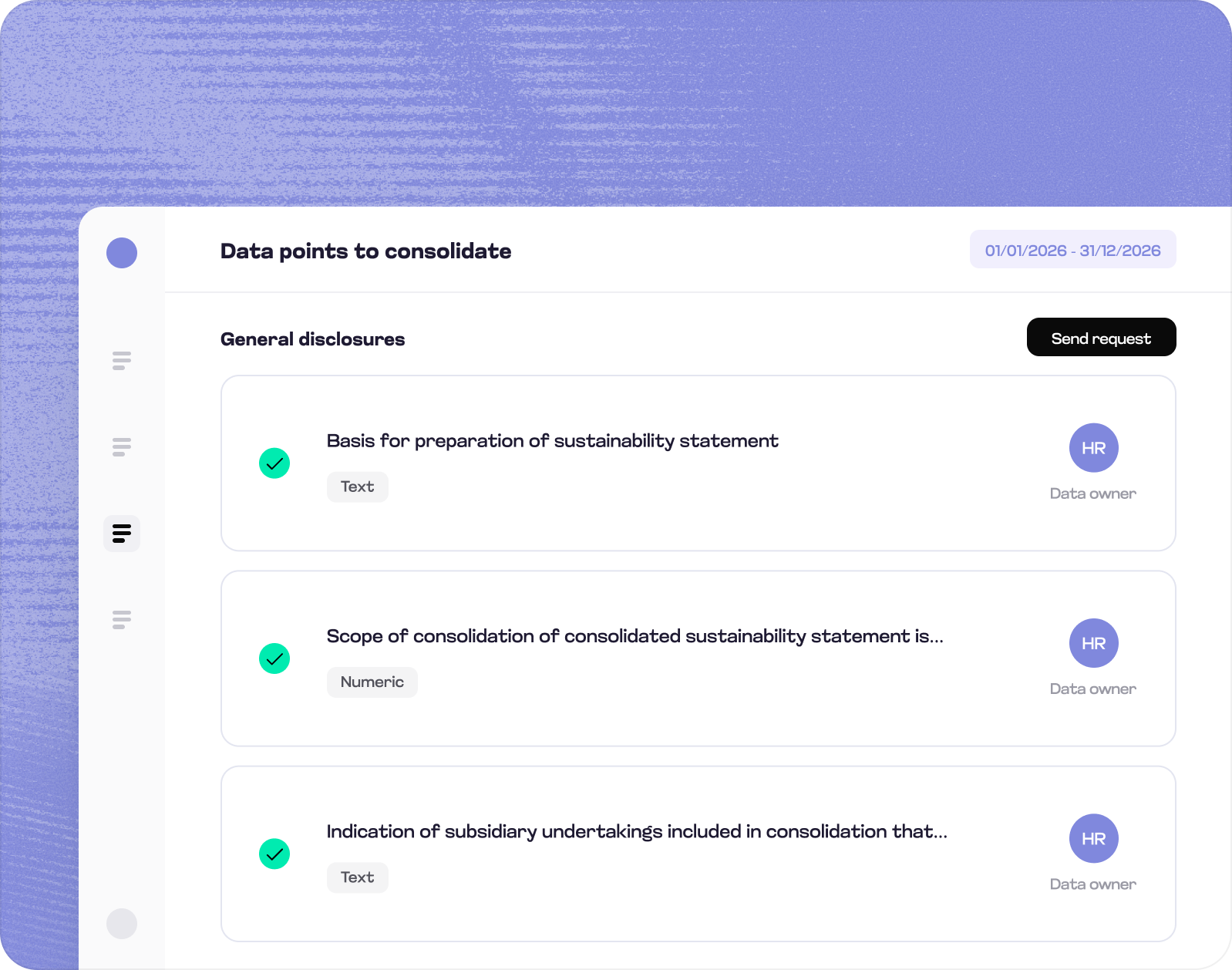
- What lands in their inbox? —> The request
- How do they answer without becoming an expert? —> Their own scoped environment
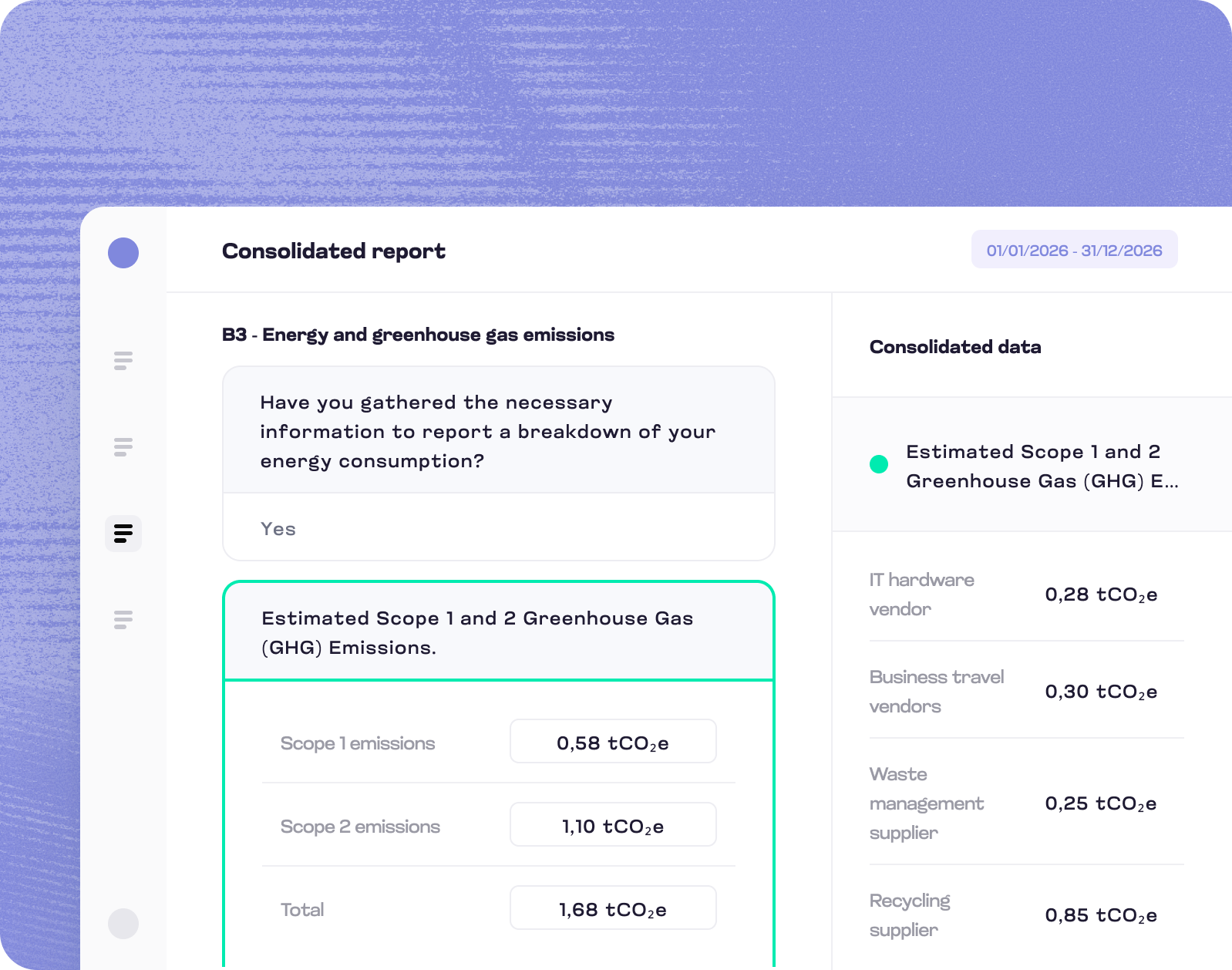
- How does it become one group number? —> The consolidated report
Your reporting structure should be the one you already run the company by. Not a second hierarchy invented for sustainability. Divisions, business units, countries, sites, and plenty of entities that are not separate legal entities at all. Sites matter in particular, because that is the level emissions are calculated at.
Nobody should be asked for a number you are not even reporting. That is why the data point set arrives preselected rather than blank. We start from the numerical points that make sense to ask an entity for, and leave out what only exists at group level. Your job is to deviate, not to build: switch off what is irrelevant for a given entity, add your own KPIs, and revert to the group default whenever you want.
One name per entity turns a form into an accountability chain. The data owner is the person responsible for the validity of that entity's data, and for pushing the request further down if they need a colleague. That single concept is the difference between a survey and a reporting process.
The person at the bottom should get the best deal in the chain, not the worst. They open their own space and see only their data points, each with a plain definition of what is being asked. They can upload documents they already have and let the AI pull the data out of it. They can tag a colleague in context instead of forwarding a file. No tabs, no formulas belonging to somebody three levels up, no guessing what column AK means.
A number nobody validated is not worth collecting. Entity data stays in the entity's own space until they explicitly share it. That is deliberate. A division head with a team still filling things in does not want group reading half-finished figures, and a data owner does not sign off on numbers they have not checked. Explicit sharing is the validation boundary, and it is what puts a name behind every submitted number.
Consolidation should not be a black box. At group level you watch it land, entity by entity, and chase the ones that have not. Then one action rolls it up into your group report. You can open any consolidated number and see which entities contributed what.
A number without a name behind it is a number you will defend alone.
What changes in practice
The clearest signal is not what the group team says. It is what happens at the entity.
A controller at a site in Portugal, a plant manager in Belgium and an HR lead in Germany do not want a project. They want a short, clear ask in a language they read, with a definition next to each question and something that fills in half of it from a document they already have on their drive. When that is what lands, the data comes back inside the deadline, and the central team spends its quarter reviewing rather than chasing.
The second thing that changes is what happens when the auditor arrives. Every number in the group report traces to an entity, an owner and a source document. Nobody reconstructs from memory how the 2025 energy figure was assembled, because the assembly is recorded.
Every number keeps its name
There is a version of automation that quietly removes people from the process. This is the opposite. The system does the mapping, the scoping, the routing and the arithmetic. The judgement stays exactly where it belongs, with the person who knows whether that number is right.
That is also why the data owner is a named human rather than a mailbox, why sharing is a deliberate act rather than a live feed, and why you can see how the sausage was made on any consolidated figure. We carry the complexity. Your team keeps the responsibility, and the evidence to back it up.
Frequently asked questions
What is sustainability data collection at group level?
The process of gathering sustainability data from the entities that make up a group, subsidiaries, divisions, countries or sites, and consolidating it into one report. Under CSRD, most ESRS metrics have to be assembled this way because they are measured locally.
Do the entities have to be legal entities?
No. Divisions, countries, sites, activities and departments all work. Many groups collect from levels that have no separate legal existence, and emissions in particular are usually calculated per site.
Which frameworks are supported?
ESRS and VSME, with the option to build configurations for others. The data points asked of an entity map to the ones you are actually reporting.
Do contributors need to understand ESRS?
No, and assuming they do is how deadlines get missed. Each data point comes with a definition, and the AI helps them answer from documents they already have.
Is there a limit on the number of entities?
No. The structure nests several levels deep, and intermediate entities can collect from their own children.
How does traceability work for an audit?
Every collected number carries the entity it came from and the data owner who validated it. Consolidated figures can be opened up to show which entities contributed what.
Send us your org chart
The report was never the hard part. Getting two hundred people to hand you a number they can stand behind is.
Show us how your group is actually organised and we will show you what collection looks like when the person at the bottom of the chain gets the better end of the deal.
Receive updates and best practices on all things ESG reporting each month.
Read More