Why EcoVadis takes weeks (and how to fix it)

Ask a sustainability manager how long their EcoVadis questionnaire takes, and you rarely get a number. You get a sigh.
The questions themselves aren't the problem. Most of the answers already exist, in the annual report, the sustainability statement, a policy on the intranet, a certificate in someone's inbox. The work is in proving them. For every answer you claim, you need the right document, the page where an analyst will find it, and some confidence that the document is dated, public and names the right entity.
Then you submit, wait six to eight weeks, and find out what didn't count.
The facts
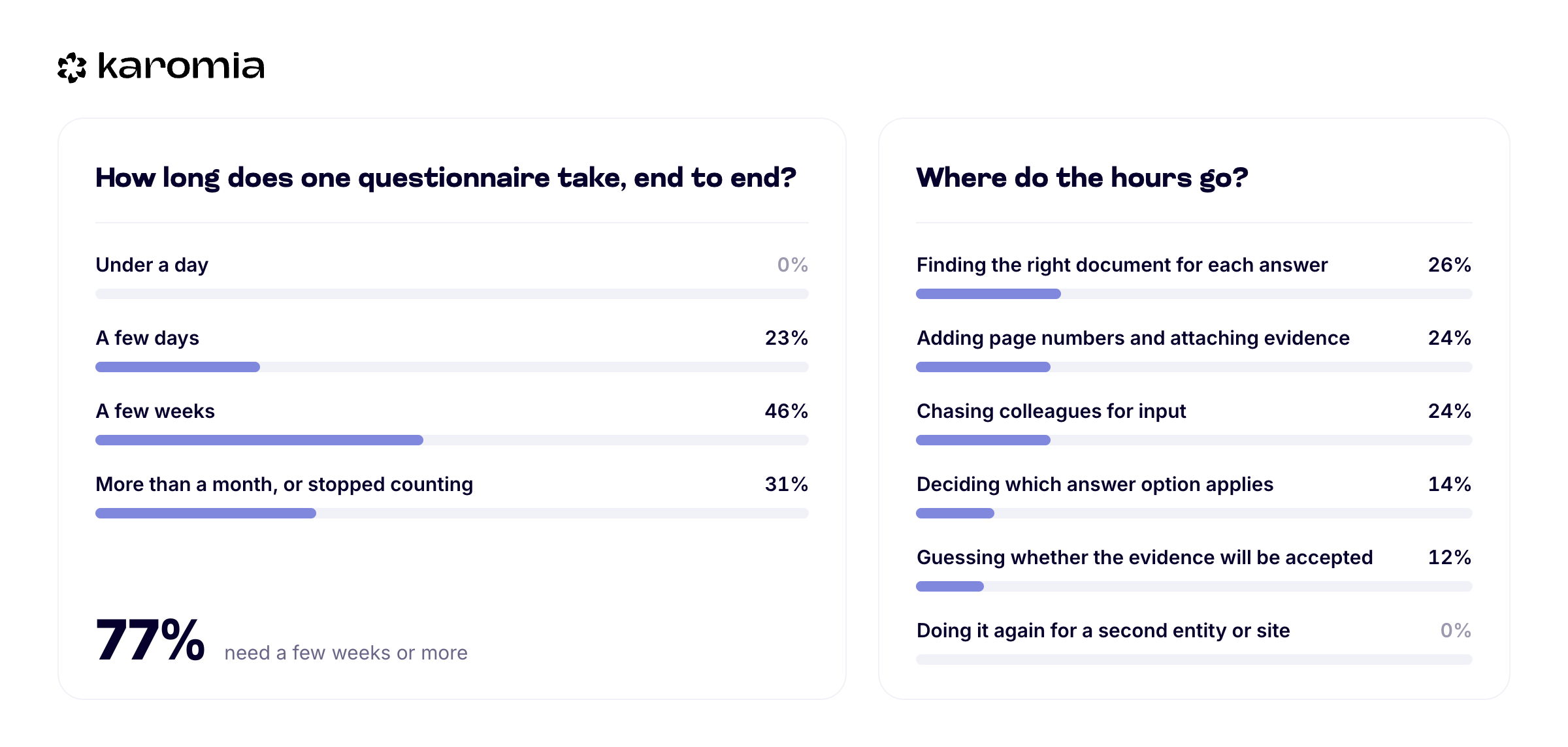
- It takes weeks. At our last live session, we asked twenty EcoVadis respondents how long one questionnaire takes them from start to finish. Nobody said under a day. 46% said a few weeks, and 31% said more than a month or had stopped counting.
- Most of that time goes into looking for documents. When we asked where the hours go, half of all votes went to two answers: finding the right document for each answer, and adding page numbers and attaching evidence. Chasing colleagues came next. Deciding which option applies, the part that actually looks like filling in a questionnaire, came well behind.
- The rules on documents are strict, and mostly about form. Policies and actions are valid for eight years, KPI reporting for two. Undated documents are rejected, and so are documents written only to satisfy the questionnaire. You can upload at most 55 documents per assessment.
- A disappointing scorecard is usually an evidence problem, not a practice problem. A sustainability lead at a Belgian staffing company went back through her scorecard and found the same comment under nearly every theme: no supporting evidence of reporting aligned with a recognised standard such as GRI or ESRS. The practices were there. The evidence wasn't in a form the assessment accepts.
"The work was never answering questions. It was proving answers you already had."
Why it stays manual
Every answer is a small research task, and there are hundreds of them. You read the question and decide which options apply. You find the document that proves each one, then the page. You check the date, the entity name, and whether the document is public. You write a comment an analyst will understand. Then you move on to the next option.
Some teams have tried to speed this up with a general-purpose chat assistant. In practice, it loses track somewhere around row 40, and it doesn't have access to your full library of sustainability documents.
What we built
Karomia's EcoVadis solution takes your own questionnaire and your own documents, and gives you back the same file, filled in and backed by evidence, with a plan for what to fix first.
- Which questionnaire are you actually answering? → Your own EcoVadis export
- Where is the evidence? → Your existing document library
- What do you get back? → Answer, document, page and analyst comment per option
- What should you trust, and what should you check? → A status and an evidence check per option
- What do you fix first? → An improvement plan and a document plan
Your questionnaire is not a fixed template. EcoVadis tailors every questionnaire to company size, sector and country. You export yours from the EcoVadis platform and upload it as it is.
The evidence is where you already keep it. Run it in Karomia and it draws on your existing sustainability reports and every document in your library. You can still add or link extra documents whenever you want.
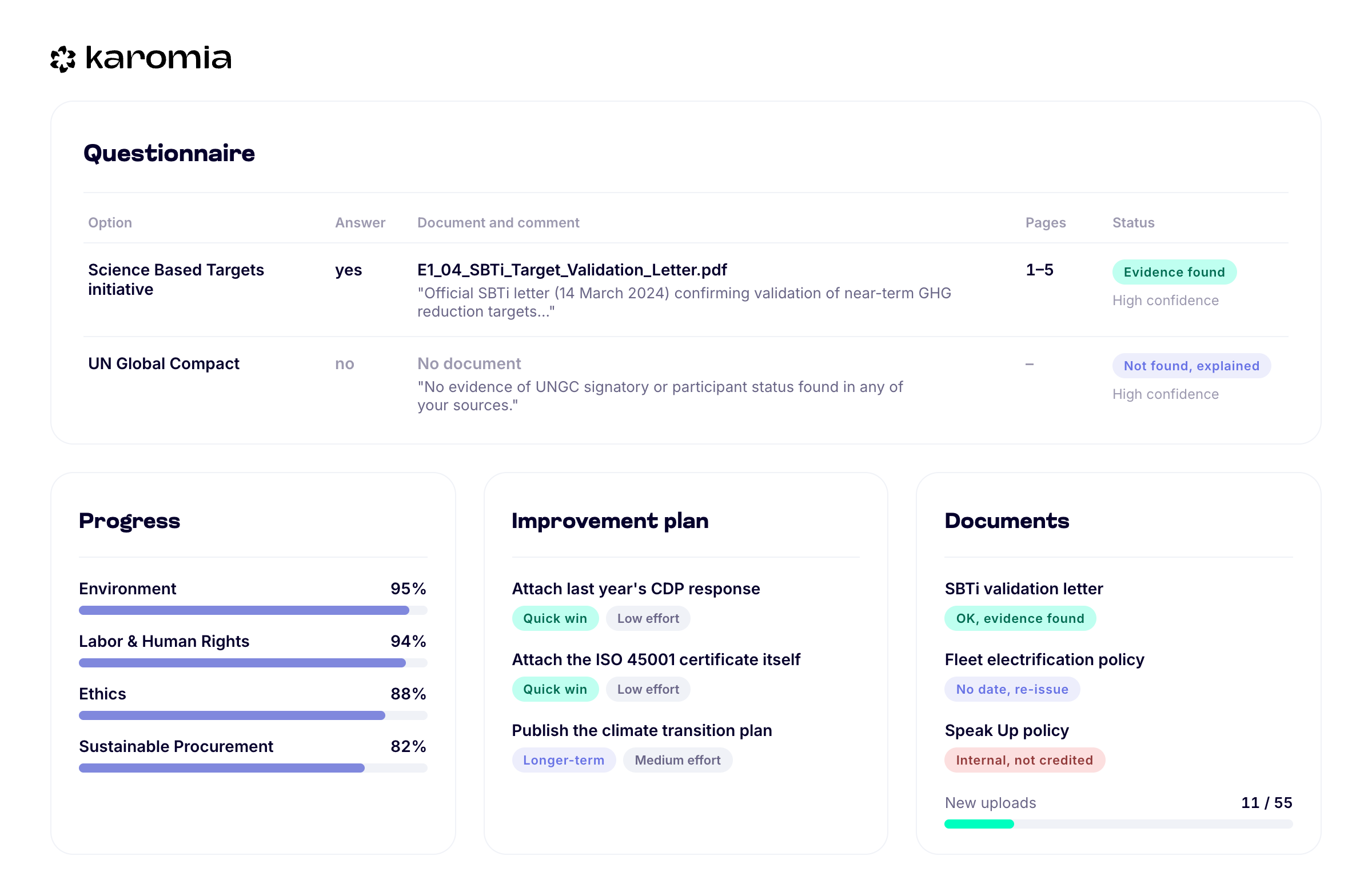
The output is your file, not ours. Same columns, same row order, and every cell in the format EcoVadis expects. For every option that applies, you get the answer, the name of the supporting document, a comment quoting what that document says, and the page numbers.
"Not found" is an answer too. Every option has a status and a confidence level. When there is no evidence, the output says so and explains why, for example that none of the 49 documents searched mentions the SDGs. It doesn't guess, and it doesn't leave you a blank cell to interpret.
"Most of the actions on the plan aren't sustainability work. They're paperwork you already own."
On real files, this is what changes
The improvement plan is usually where people get surprised. Not by what they lack, but by what they already have and haven't used.
Take a company that answers yes to "Are you a CDP respondent?". The annual report confirms it, score included. The answer still won't be credited, because EcoVadis wants the CDP response itself, not a sentence mentioning the score. The fix is to download last year's response and attach it, which takes a few minutes.
The documents sheet looks at the same problem per document rather than per question. It lists what each document supports and whether it will be accepted as it stands. It also counts your new uploads against the 55-document limit and tells you what's still missing. Typical findings:
- A fleet electrification policy with no effective date. Re-issue it with one.
- A Speak Up policy marked internal. Publishing it strengthens two ethics answers.
- An anti-bribery policy that's public on your own website, but only referenced inside the annual report.
- A climate transition plan that won't be credited until it's published.
You don't need new sustainability initiatives for any of these. Yet each one costs you an answer.
Faster, and still yours to submit
The first draft is fully machine-produced. You still review all of it, but quickly: the status, confidence and evidence columns point you to the rows that need attention, so you don't have to go through every one. The tool drafts the answers and finds the evidence. You make the calls and submit.
There are two things it deliberately doesn't do. It doesn't predict your score, because nobody outside EcoVadis can, and anyone who gives you a number is estimating. And it doesn't write documents for you. EcoVadis rejects documents created for the questionnaire and checks for copied material, so we only find, quote and reference documents you already have.
There's also no direct integration, as EcoVadis doesn't let outside tools write into its platform. You copy the answers across and upload the documents yourself. Since the columns and row order stay the same, that's a matter of copy-paste, not re-typing.
Frequently asked questions
How many supporting documents can I upload to EcoVadis?
Fifty-five new documents per assessment. Documents accepted in a previous assessment can be relinked, as long as they're still valid.
Can I answer a question without a document?
You can submit it, but the answer won't be credited. What helps is knowing which answers have no document behind them before you submit, while there's still time to fix it.
How long does a supporting document stay valid?
According to EcoVadis, eight years for policies and actions, and two years for KPI reporting. Validity is checked against the date of the new assessment, which is why a score can drop even when nothing about your practices has changed.
Does my ESRS or VSME report count as evidence?
Yes, and it helps in two ways. It supports answers across all four themes, and reporting against a recognised standard is something the assessment looks for in its own right. Where the report answers a question, we cite it and show the documents behind it.
We have several entities. Can I run it once for all of them?
Today it's one run per entity, based on that entity's report and documents. EcoVadis assesses each entity separately, with its own questionnaire and its own evidence.
Does it work for other questionnaires?
Yes. Customer, bank and supplier questionnaires go through the same flow. The EcoVadis-specific evidence checks don't apply there, so you get answers and sources, but not the evidence review.
Send us your blank questionnaire
The answers are already in your documents. What made this take weeks was never a lack of knowledge. It was the admin.
Export your questionnaire from EcoVadis and we'll show you how much of it is already answered, where the evidence is thin, and what to fix before you submit.
Receive updates and best practices on all things ESG reporting each month.
Read More