









Four obligations. One platform, one data trail.
CSRD/ESRS compliance
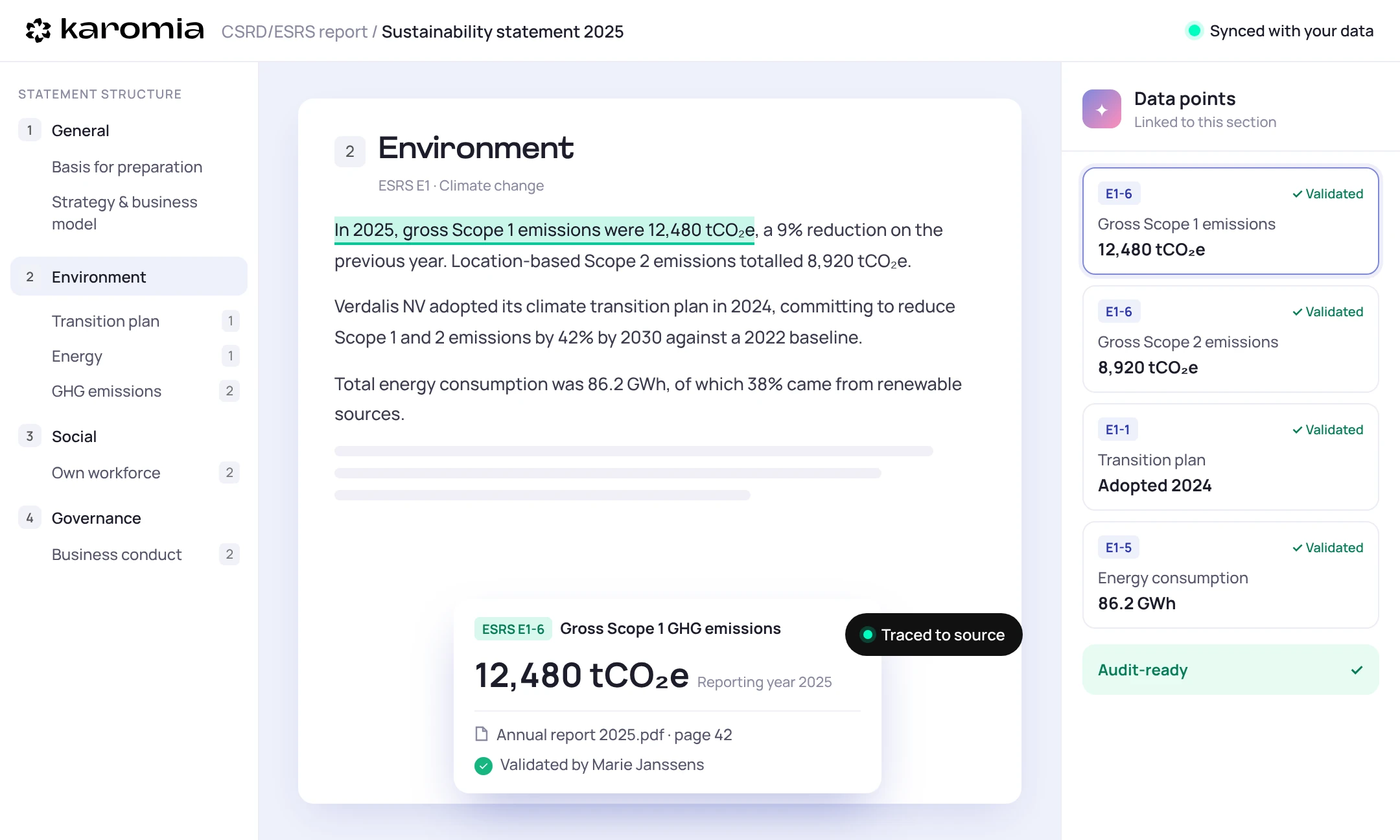
Your ESRS statement, built the way a bank’s auditor expects
Every figure in your statement is linked to its validated data point and its source, so assurance becomes a check, not a search.
- A double materiality assessment that covers your own operations and what you finance
- Every ESRS data point linked to its source, with the full audit trail
- Group figures consolidated across entities, with the rule for each
- Ready for the simplified ESRS
Carbon management
Financed emissions, counterparty by counterparty
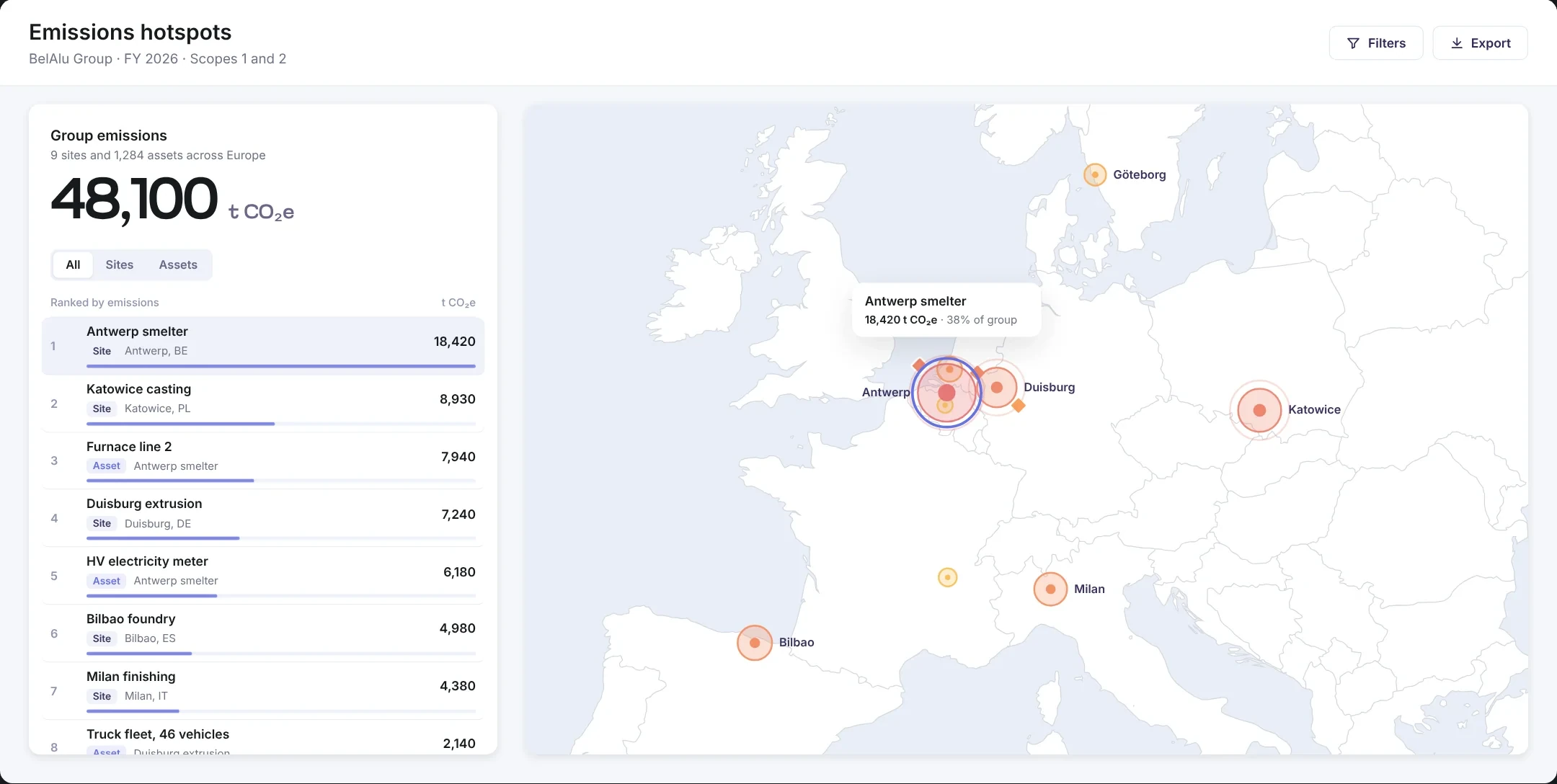
For a bank, most of the footprint sits in the loan and investment book: Scope 3, category 15. Karomia calculates financed emissions per counterparty and per asset class, with the data quality of every figure on record.
- Emissions attributed per counterparty, following the PCAF standard
- Reported emissions where clients have them, estimates where they don’t, each with its data quality score
- Hotspots by sector, counterparty and asset class, to steer engagement and targets
- The same audit trail as the rest of your ESRS E1 disclosure
CRD6 compliance
Primary ESG data from every client, without chasing them
CRD6 makes ESG risk part of how a bank is run, and the EBA guidelines spell out the client data that takes. With Karomia, your clients produce their VSME report from their own invoices, payroll and site data, and share it with you as structured data.
- A VSME report per client, filled in from their own records
- The EU’s voluntary standard for SMEs, not one more bank questionnaire
- Reported once, shared with every bank and partner that asks
- Structured data, not PDFs: ready for your ESG risk assessments, risk models and Pillar 3
Kube ESG, with Febelfin, Isabel and the four largest Belgian banks
The VSME channel between Belgian companies and their banks, built by Isabel and Karomia at the initiative of Febelfin, with Belfius, BNP Paribas Fortis, ING and KBC.
Read the announcement
Kube ESG in the press
- De Tijd“Banken helpen kmo’s duurzaamheidsrapport op te stellen”Read the article
- L’Echo“Avec KUBE, toutes les PME belges peuvent désormais publier un rapport de durabilité”Read the article
- Trends“Isabel lanceert KUBE: ESG-duurzaamheidsrapportering toegankelijk voor kmo’s”Read the article
- Febelfin“Kube makes sustainability reporting accessible for SMEs”Read the article
- Febelfin“New common digital platform for uniform sustainability reporting for SMEs”Read the article
- Isabel & Karomia“Isabel and Karomia partner to simplify ESG reporting via Kube”Read the article
Climate risk assessment
Climate risk data your risk team can defend
Most climate risk tools hand a bank one score per coordinate, from a global model, with no way to check it. Supervisors, auditors and your own model validation ask for more.
For banks and investors
Send company names. Get site-level risk back.
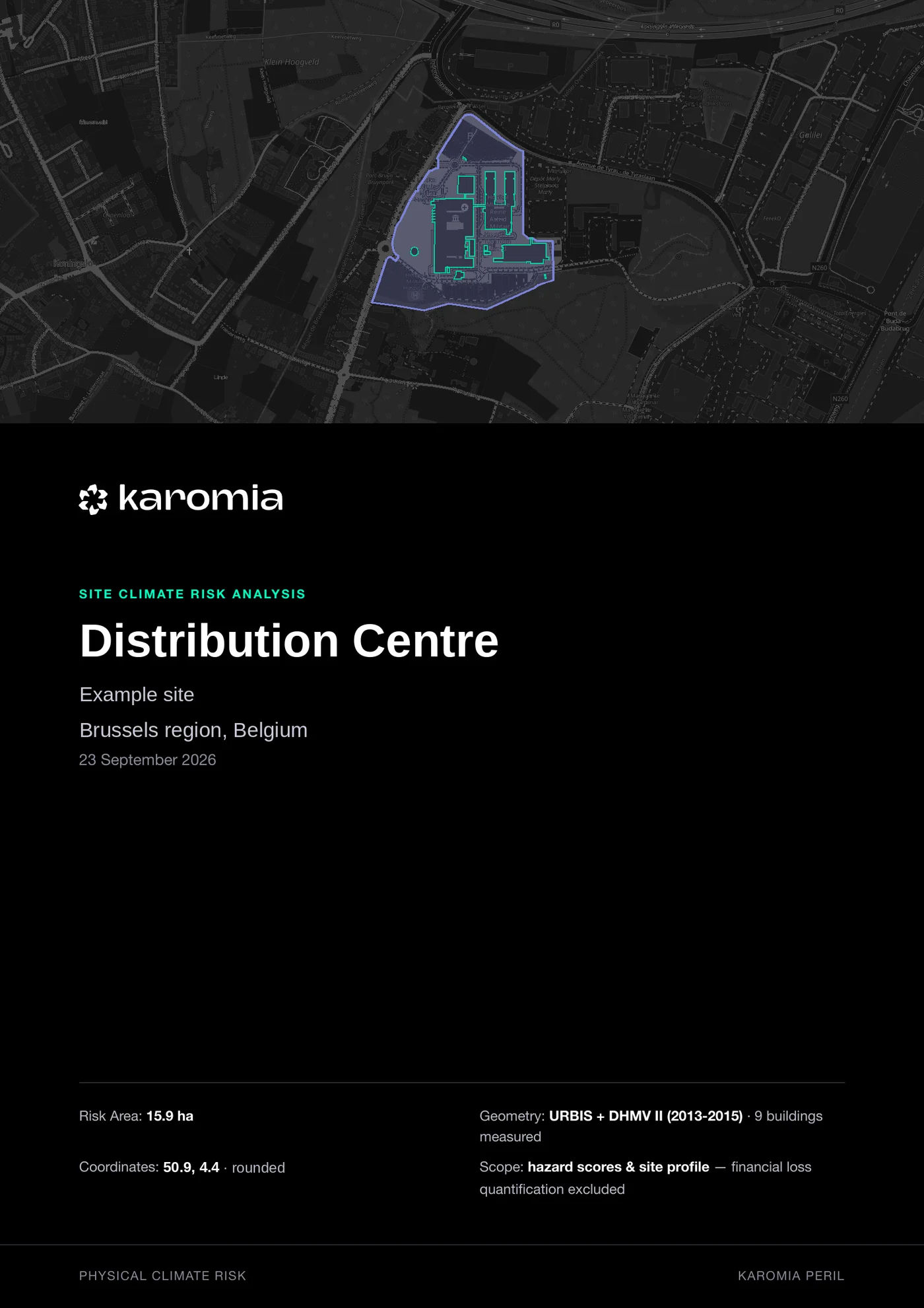
Most borrowers and portfolio companies can’t hand you a clean list of their sites. We find them, map each one to its parcels and return hazard and nature data per site, ready for your own risk models.
- 1
Send company names
A list of borrowers or portfolio companies, by name or company number.
- 2
We find their sites
Karomia’s deep-search finds plants, depots, warehouses and offices, from company sources and official registers, each with its source.
- 3
Each site gets a risk area
Cadastral parcel references and a polygon where available, a coordinate-based fallback where not.
- 4
Data back your way
Hazard, scenario and nature data per site, as a batch feed over API, or in the platform.
Use it for
- Portfolio and collateral screeningLink loans and holdings to the physical risk of the sites behind them.
- Climate and nature risk managementFeed parcel-level exposure and protected-zone data into stress tests and Pillar 3 ESG work.
- EBA Pillar 3 ESG disclosuresSite-level physical risk data for the template on banking-book exposures subject to physical risk.
- EU Taxonomy and green asset ratioClimate risk and vulnerability assessments of counterparties’ sites, as input for Taxonomy alignment and your GAR.
- Investment due diligenceAttach a site-level climate and environmental risk report to the investment memo.
- Built to scaleDesigned for thousands of companies, with the output schema agreed with your data team.
Questions banks ask us
Don't see your question? Talk to our team, we're happy to help.
CRD6 requires banks to identify, measure, manage and monitor ESG risks as part of their strategy and risk management, and to draw up plans for the risks of the transition to a climate-neutral economy. The EBA guidelines on the management of ESG risks set out how, including the ESG data banks need from their clients. Karomia lets your clients produce that data as a VSME report, from their own records, and share it with you as structured data.
Yes. Karomia built Kube ESG with Isabel, at the initiative of Febelfin and with the support of Belfius, BNP Paribas Fortis, ING and KBC: the channel through which Belgian companies share their VSME report with their banks.
Per counterparty: the emissions of each client or investee, attributed to the bank by its share of the financing, following the PCAF standard, and added up per asset class and sector. Where a counterparty reports its emissions, we use them; where it doesn’t, we estimate them, and every figure carries its data quality score.
Yes. Send a list of borrowers or portfolio companies; we find their sites, map each one to its parcels and return hazard, scenario and nature data per site as a batch feed over API, in a schema agreed with your data team. Every score comes with the raw measurement and the dataset behind it, so your model validation can follow it.
Yes. Every site, anywhere, is assessed on international reference data from Copernicus, the European Commission’s JRC, WRI Aqueduct and NASA’s downscaled CMIP6 projections, with finer local datasets wherever countries and regions publish them. The same scoring thresholds apply everywhere, so sites on different continents can be compared.
Yes. Most banks start with what is due first, often their own ESRS statement or a climate risk screen of part of the portfolio, and add the rest on the same data later.
See it on your own portfolio
Book 30 minutes. Bring a few client names and we’ll show you their sites, their climate risks and the ESG data you’d get from them.